Asian Caesar's Mushroom
Amanita hemibapha / A. caesareoides
Family: Amanitaceae
Also called: Asian Caesar, Tamogitake, Hong Yundan, 红云丹
Overview
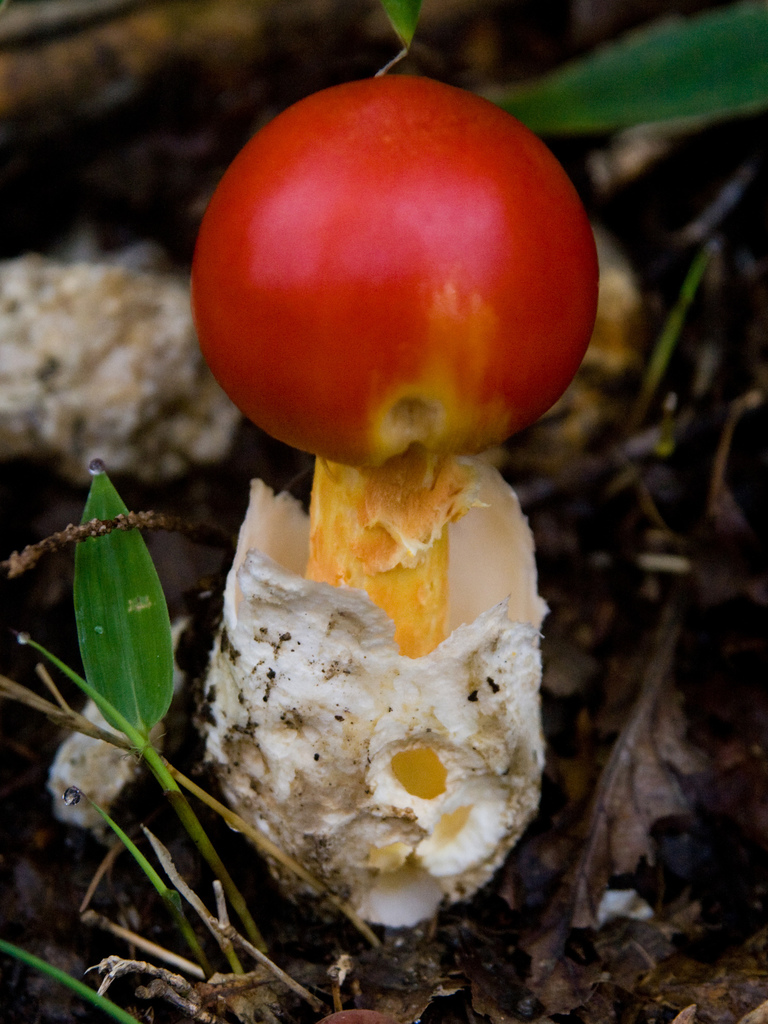
Asian sibling clade of the Mediterranean Caesar's mushroom. Bright orange cap, yellow gills, yellow stem with skirt, white cup at base. Oak and Castanopsis forests of Yunnan, Sichuan, Korea, and Japan. Identification must be confirmed in hand by an experienced forager.
Conditions when it's found
- Soil temp, past 3 days
- Usually 67°F to 81°F · typical 76°F
- Air temp, past week
- Usually 68°F to 82°F · typical 77°F
- Night lows, past week
- Usually 61°F to 79°F · typical 71°F
- Rain, past 2 weeks
- Usually 0.82 in to 8.41 in · typical 4.76 in
- Topsoil wetness
- Usually 68% to 95% · typical 77%
From the weather before 19 dated records on GBIF.org, using NASA POWER daily data. "Usually" covers the middle 80% of records. A guide to when it shows up, not a guarantee.
Season
Jun–Oct — typical fruiting months: May, Jun, Jul, Aug, Sep.
Host trees & substrate
- Quercus
- Castanopsis
Toxic lookalikes
- Death cap (Amanita phalloides)deadly
Different colour but same genus — never collect any Amanita without an expert eye.
- Fly agaric (Amanita muscaria)toxic
Red cap usually with white patches; gills white not yellow.
Where it grows
See live fruiting predictions for Asian Caesar's Mushroom on the forecast home page, or browse the full field guide.
Always confirm wild-mushroom identification with multiple sources and a knowledgeable local expert before consuming. Read the foraging safety guide.